
Sun is shining brighter

Sun International hosted a capital markets day on Tuesday and made the presentation available online, which is always a great opportunity to learn more about a listed company. In this case, it’s all about the glamorous world of casinos and hotels, which weren’t so glamorous in 2021 and 2021.

Since the start of 2020, Sun International has lost nearly 30% of its value. Needless to say, there were times when things looked a lot worse than they do now. Over the past year, the share price has put in a strong recovery of over 55%!

The group owns 11 urban casinos, including the iconic Sun City Resort as its most famous venue for bad decision-making and good memories. Carnival City, GrandWest and Sibaya are also in the portfolio, along with Golden Valley which entertains the people On The Other Side Of The Tunnel in Worcester.

In the five months to May 2022, revenue was up 34% and adjusted EBITDA jumped by over 80%. One thing you need to understand about the hospitality industry is that operating leverage is substantial. This means that any percentage impact in revenue is amplified at operating profit level. This applies on the way up and the way down.

The operations have bounced back considerably, with income over the five months running at approximately 92% of the comparable period in 2019. Adjusted EBITDA margins have improved thanks to major cost cutting and efficiency projects during the pandemic, so adjusted EBITDA is higher now than in 2019. The group is aiming for further improvement, including between 200bps and 400bps in the Casino segment by FY26.

Of R4.29 billion in income over this five-month period, just over 60% is from the Casino segment. If gambling bothers you, then Sun International isn’t for you. There’s nearly a 23% contribution from Resorts and Hotels and 14% from Sun Slots, with the rest from Sun Bet (a sports betting business).

The Resorts and Hotels segment posted the highest year-on-year growth (62.3%) with Sun Slots the slowest at 15.9%. This is hugely skewed by the relative impact of the pandemic on the different segments, so I wouldn’t read too much into this.

There was a great chart in the presentation that I’ve included below to demonstrate how the pandemic hammered the Casino segment in particular:
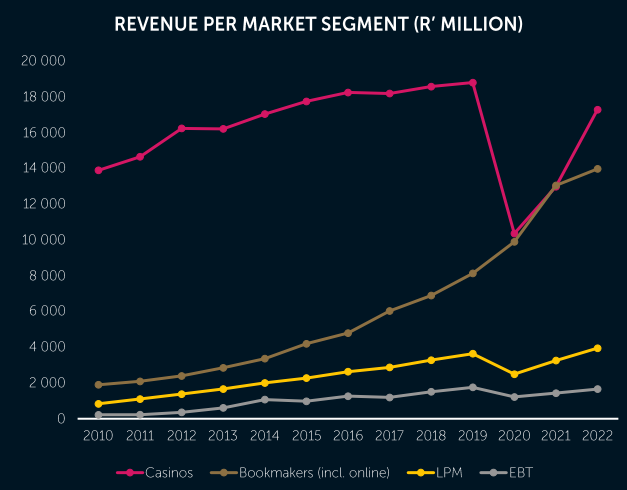
Importantly, the group managed to reduce debt from R6.4 billion at the end of December 2021 to R5.8 billion by the end of May. With interest rates clearly on the up, Sun International needs to keep chipping away at the debt.

Luckily, these businesses practically print cash once the initial build cost is out of the way. Annual capital expenditure is only around 5% to 7% of revenue, with Resorts and Hotels being the most cash hungry with 10.3% of revenue expected to be invested in capital expenditure in FY22.

I also found it interesting to see how EBITDA margins can vary in the different Resorts and Hotels. For example, the ambition at Sun City is to grow EBITDA margin to over 20% by FY24, yet the Table Bay Hotel is only aiming for over 15%. These are totally different business models of course, so I’m just including these as interesting nuggets to help you learn about the industry.

If you would like to flick through the entire presentation, you’ll find it at this link.

With masks now a thing of the past, the outlook for Sun International is looking a lot brighter. The sooner that the debt balance comes down, the better.

1 comment

  1. The problem I have with these significant Businesses like SUI is the lack of introspection and indeed, circumspection when confronted with a challenge that could derail the business and the industry. What steps did the Company take to validate that the alleged pandemic was a fact?! What measures did they take to assess the potential harm caused to health by certain mandates like wearing a mask (face covering)? Will a business like SUI simply follow the mandates once again simply because some bureaucrats in politics or in the UN sound an alarm with little tangible evidence to substantiate their claims?
    Where are the South African brass balls, a pair to simply hold the legislators accountable.

Leave a reply

Please enter your comment!
Please enter your name here

Latest Articles

Boring business billions

The world’s richest people aren’t always building apps or chasing disruption. Here are three stories that reveal how unglamorous industries keep minting billionaires. From billboards to pig farming and car mats, there are many ways to make it big.

Ghost Bites (AB InBev | Jubilee Metals | HCI | Schroder European Real Estate)

With all the news from the first week of January 2026 included in one Ghost Bites, you'll find deal news at AB InBev, Jubilee Metals and HCI. There's also a valuation update at Schroder European Real Estate.

Why ETFs Play a Vital Role in Private Markets

Exchange Traded Funds (ETFs) have emerged as a transformative solution, for public markets and also as a strategic bridge to private market exposure. The border between traditional and alternative asset management is dissolving. Clients are driving the convergence, seeking integrated solutions that blend public and private exposures. Duma Mxenge of Satrix explains.

Ghost Bites (AfroCentric | Aspen | Novus – Mustek)

Aspen announced the disposal of Aspen APAC and the market loved it. AfroCentric is disposing of Activo and the market forgot to notice - for now, at least. And for Novus, a purchase of 3,000 shares has turned out to be very expensive in the Mustek deal.

UNLOCK THE STOCK: Southern Sun

In the 65th edition of Unlock the Stock, Southern Sun joined the platform to talk about the recent numbers and the strategic outlook for the business.

Ghost Bites (Mr Price | NEPI Rockcastle)

Mr Price isn't backing off on the NKD deal, despite the absolute hatred for the transaction from the market. NEPI's pre-close update shows the importance of looking at per-share growth.

Sponsored

Ghost Stories #89: 25 years of Satrix – how indexation changed investing in South Africa

In the year 2000, a lot happened. There was some questionable pop music. There was also the Dot-Com Crisis, followed by a period that saw incredible equity returns in South Africa until the Global Financial Crisis hit in 2007/2008. And during that important period in our local market, we also saw the emergence and initial growth of ETFs in South Africa, spearheaded by Satrix. To reflect on 25 years of ETFs in South Africa, René Basson joined me to share the important milestones and fascinating stories that defined this journey. Join us as we look back on how Satrix made it possible for everyone to own the market.

The Finance Ghost Plugged in with Capitec: Ep 6 (Noodles without borders – bringing miso to Mzansi)

Lu-ise Hattingh and Ruan Botha are a great example of the power and value of travel. After spending time in Japan, they fell in love with the culture and food. As all great entrepreneurs do, they also took the opportunity to learn about the Japanese approach to consumer brands. That curiosity eventually sparked a business idea they brought back home. Today, Lu-ise and Ruan are rolling out Market Kokoro franchise stores in South Africa.

Ghost Stories #88: Cell C – more than just an MVNO engine

Cell C has been on quite the adventure in its efforts to carve out a sustainable competitive position. Cell C has created a profitable business model that goes well beyond the MVNO operations that the market tends to focus on. In this podcast, CEO Jorge Mendes joined me to explain Cell C's business and how they plan to win across key verticals.

Ghost Stories #87: Lessons from 2025 – discipline over drama

As we look back on a fascinating year in the markets, Nico Katzke (Head of Portfolio Solutions at Satrix) delivered a fantastic mix of insights on this podcast that can be applied to your strategy in 2026 and beyond. From being careful not to learn the wrong lessons through to choosing simplicity over complexity, there's a lot of great stuff in here to get you ready for another year in the markets.