
Despite STADIO being a future-focused tertiary education business with 84% of students enrolled for distance learning, the corporate website is truly appalling. If you can look past the font that assaults your eyes when you visit the website, you’ll find a business that is doing good things.
At STADIO’s AGM on Wednesday, the company used the opportunity to deliver a presentation about the business. The group was established in 2016 and grew quickly through acquisitions. Building a business takes a long time, so buying one and creating a platform for further organic growth is a tried and trusted strategy.
To set the scene, I’ll quote a great line from the presentation:
“We want to be the alternative to UNISA.”
The group currently has 38,000 students across South Africa and the rest of Africa, so one day UNISA may describe itself as wanting to be the alternative to STADIO.
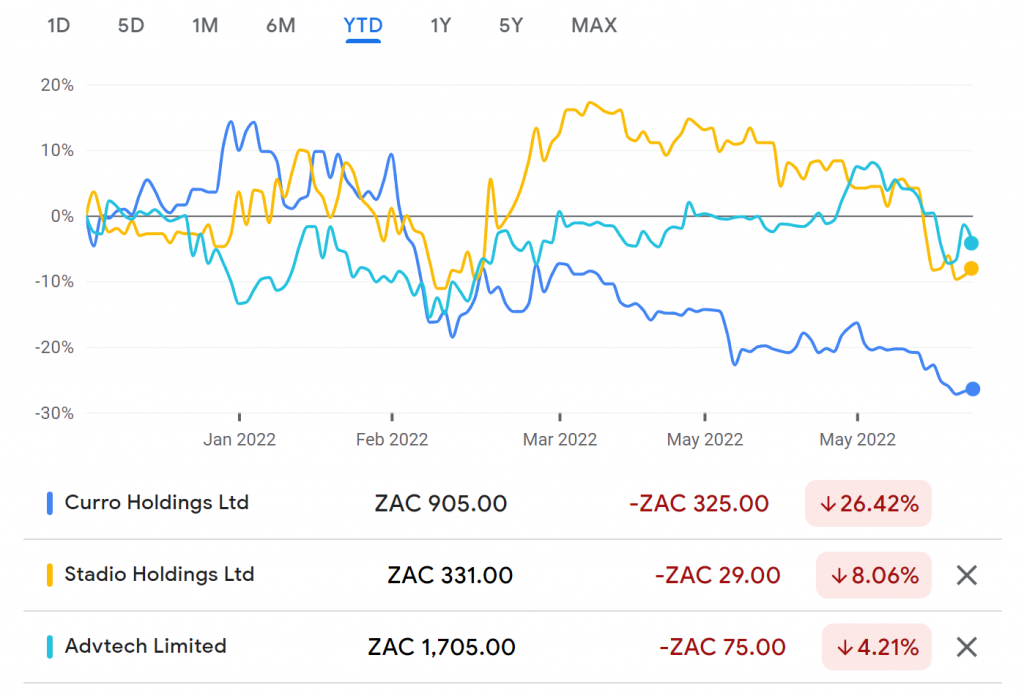
Before we go into further detail on STADIO, here’s a chart of the year-to-date performance of the three education stocks on the JSE:
Interestingly, STADIO says that it has only just “entered the growth phase” after a few years of establishing itself. The presentation talks about achieving a 20%+ growth rate going forward with minimal capital expenditure.
The group has been set up with three distinct platforms:

- STADIO Higher Education,
- AFDA (the leading film school in South Africa)
- and Milpark Education (a business school focused on online education).
In my view, the STADIO Higher Education business is the most interesting. A quick look at the daily lives of South Africans reminds us that we need private security, healthcare and schools to ensure that we get a decent level of service (there are some exceptions of course). We are quickly going the way of private power generation as well, with ESKOM clearly unable to fix its issues.
In the next 10 years, will we see public universities go the same way?
With plenty of disruption from fee and other protests in recent times, it’s really not hard to make a case for demand for private universities. In addition to the more sensitive political issues, there’s a simple numbers game at play here: there are more matrics eligible for higher education than there are spots available at existing facilities.
STADIO steps perfectly into that gap, with the presentation noting that a School of Engineering and School of Humanities will be coming soon. STADIO already offers numerous courses across law, finance, IT and other fields of study.
The 2021 numbers have been known to the market for a while but they are worth repeating. In the year ended December 2021, student numbers grew 9% and revenue grew 18%. Adjusted EBITDA grew 23% and core headline earnings per share (HEPS) increased by 24%. You can see how operating leverage cascades down the income statement, as a percentage increase in revenue drives a much larger percentage increase in profit.
The joy of an education business is that once you have the infrastructure in place, growth in student numbers “drops to the bottom line” as the unit economics are excellent. This is true economies of scale.
STADIO has very little debt on the balance sheet and has access to a R200 million facility. The strength of the balance sheet was made clear to the market when the group declared a rather surprising maiden dividend related to the 2021 financial year. The dividend size of just 4.7 cents was less important than the signal to the market that STADIO is now a dividend-paying stock.
The group’s strategy is to target 80% distance learning and 20% contact learning in its student numbers. To reach the target of 56,000 students by 2026, 8% annual growth in student numbers is required. Between June 2021 and May 2022, student growth was 11%. None of these goals sound overly ambitious to me, so I wouldn’t bet against STADIO achieving them.
STADIO’s core HEPS in 2021 was 17.6 cents. The share price is R3.35, so the trailing Price/Earnings multiple is around 19x. If the growth rate of 20% in earnings can be maintained, the PEG ratio (P/E divided by the growth rate) is around 1x, which is a good rule of thumb when it comes to valuations. In other words, STADIO makes a strong case for itself at these levels.

Would like to know more about Stadio
Hi Michael – you should visit the Stadio investor relations website and read through the company reports