
Chris Gilmour gives us his views on the latest developments in the war in Ukraine, which comes against a backdrop of increasing global interest rates.
There were a number of big geopolitical and economic events last week that will have far-reaching effects on the global economy.
As anticipated, the US Federal Reserve (the Fed) raised its Fed Funds rate by a further 75 basis points to a target range of 3% to 3.25%. The expectation is for another 125 basis points of interest rate increases from the Fed by year end. This will put further upwards pressure on global central banks to act likewise.
In the UK, the new Chancellor of the Exchequer, Kwasi Kwarteng, attempted a somewhat radical approach to kick-start the moribund UK economy with an ambitious “trickle-down” plan.
And in Ukraine, Russia appeared to up the ante with respect to the ongoing grinding conflict.
The focus: Ukraine
Hot on the heels of the Shanghai Cooperation Organisation (SCO) meeting in Samarkand the previous week, where he was publicly admonished by China’s Xi Jinping and India’s Narendra Modi for his continued invasion of Ukraine, Russian leader Vladimir Putin ordered a “partial mobilisation” of reservists.
This is Russia’s first mobilisation since 1941, when the Nazis invaded the Soviet Union in Operation Barbarossa. Attempting to interpret this action is at once confusing and at the same time completely understandable, considering what has driven Putin in the past.
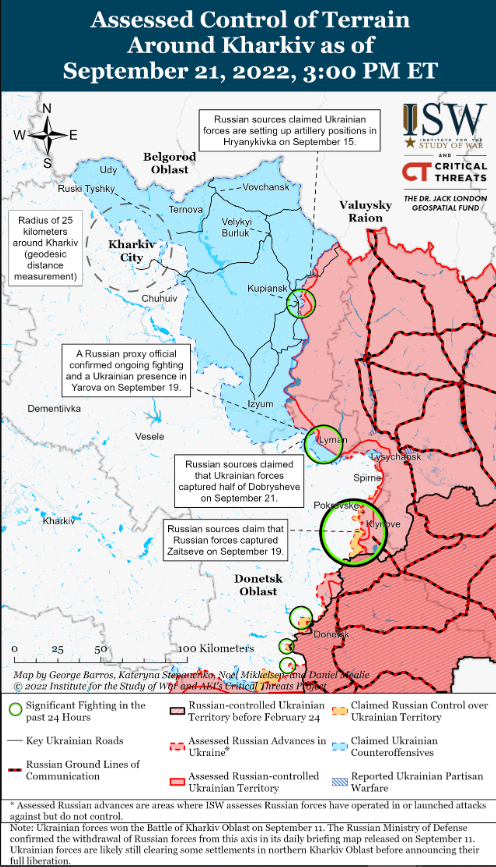
Most western analysts agree that this call-up is an act of desperation by Putin. Up until now, the Russian military operating inside Ukraine has mainly consisted of Ukrainian separatists, Wagner Group and Syrian mercenaries and ethnic minorities such as Chechens and Mongols. Again, the overwhelming consensus among these analysts is that this “special operation” has been a catastrophic failure insofar few if any tangible objectives have been achieved and the casualty toll has been immense.
Of course, the Russians and their denialist allies ignore the battlefield statistics and persist with smoke and mirrors, insisting that all of this is part of a grand plan.
Nothing could be further from the truth.
The reason Russia has resisted a mobilisation up until now is that under Russian law, reservists can only be conscripted in the event of war, not so-called “special operations”. By resorting to a call-up, partial or otherwise, the Russians are now admitting that this is war and no longer a limited special operation.
So what is the likely outcome of this call-up? Firstly, if media reports inside Russia are to be believed, this is a deeply unpopular mobilisation and many reservists are clamouring to leave the country, rather than fight in a war that they feel neither justified nor winnable. Russian airlines have been told to stop issuing any tickets to anyone wishing to fly out of the country for the foreseeable future. These are unlikely to be highly motivated troops. The people they are replacing in the battlefield are exhausted after seven months of fighting and desperately need to be replaced.
Secondly, even if they were motivated, these reservists have received little or no training in recent times and are not exactly battle-hardened troops. And the way in which these reservists are being selected appears to be quite random. Reports are circulating that police are literally handing out call-up papers to protestors and other “undesirables” in a form of retribution against them. Again, hardly the best way of ensuring that the best new troops are brought into the fray.
Finally, the Ukrainians are fighting for their very existence and remain totally motivated. They are focused on regaining all the territory taken from them earlier in the war. They are getting close to their target of having a million soldiers under arms and this compares more than favourably with the Russian army, even after the mobilization of a further 300,000 reservists. In total, the size of the Russian army in Ukraine post the call-up will be around 600 000 troops.
More of the same?
The likely outcome in Ukraine is more of the same. Russian military hardware remains obsolete and suffers from a lack of proper maintenance. Russia’s lack of success is due more to those factors than to having dominance of infantry. The Ukrainians have been able to access high-tech US military hardware and have used it very effectively. That will continue and will continue to wreak havoc with Russian military infrastructure.
As for Putin’s none-too-veiled threats of detonating a tactical or even a strategic nuclear device, that is all bluff in my honest opinion. He knows full well that exploding a tactical nuclear device on the battlefield will open Russia up to nuclear retaliation in one form or another, or even just greater conventional involvement by the west.
Moreover, this type of action would attract a degree of opprobrium from Russia’s Chinese and Indian allies that would be impossible to ignore.
A strategic strike as in a missile attack on London or Paris or Berlin for example would ensure swift nuclear retaliation from NATO, the end result of which would be mutually assured destruction and a global nuclear winter.
Nobody wins under that situation. Putin is bad, not mad and it’s highly improbable that he would risk taking the entire world down over Ukraine.
The clock keeps ticking
Putin will now be hoping for a quick resolution to this war. That’s unlikely to happen, for all the reasons mentioned previously. Russia is busy organising a series of sham referenda in the occupied territories that will only be recognised by Russia and its surrogates.
But time is not on Putin’s side. Sanctions are becoming more effective with every passing day. As the world enters recession, the price of energy drops, further damaging his oil and gas receipts. The only thing that can realistically help him now is for a crack to appear in NATO’s resolve. As the northern hemisphere winter really begins to bite, certain EU members may begin to cave.
But provided the bulk of them vasbyt, the sanctions policy will eventually force Putin out of Ukraine.

You may know something about finance but your Ukraine ignorance is clearly showing. You ignoring the history of this conflict and the American coup of 2014 and the approx 14000 (UN numbers) that were killed in the Donbass area by Ukrainian bombing. American led Nato has been preparing their since 2014. Acknowledged by Jens Stoltenberg. If so where have they been since Feb 24 ? The ruble did not turn into ruble as predicted by delusional Biden. This is a proxy war driven by the US, everyone now knows it. If they signed the Minsk 2 agreement this could all have been avoided. It was already agreed by Germany & France and Russia. But the yanks said no !
No one can live in a world that if you disagree with America you get sanctioned. That is why China and Russia stood up and said no more, which is damn good thing.