
There may be 26 letters in the alphabet, but one has been getting more attention than the others recently: the letter X.
Elon Musk’s mysterious rebrand of The App Formerly Known As Twitter has garnered a mixed bag of opinions, from those who are lauding the billionaire’s plan to transition the digital soapbox into a broader-use app, to others calling the move brand suicide.
Of course, this isn’t the first time that we’ve seen this kind of rebrand in the tech space. Musk fans may argue that the media’s adoption of “Meta” instead of “Facebook” indicates the possibility of the general public eventually accepting a new name for Twitter.
That’s all well and good, but keep in mind that the media’s adoption of a new name is not the same as acceptance by the majority of the public. Journalists have a professional obligation to report the latest official names of companies and individuals. This doesn’t necessarily guarantee that the public fully embraces Meta or that the transition has been seamless.
The key difference here is that Musk hasn’t just rebranded the company, he’s rebranded the product.
Habits are hard to break
People are generally resistant to change, especially when it comes to established and well-known brands.
Tech companies face particular user resistance when trying to impose a new name or rebranding on their platforms. Users may read such efforts as corporate marketing strategies rather than genuine attempts to improve the platform. This scepticism can lead to pushback, and people may intentionally stick to the original name as a form of resistance to corporate influence.
For this reason, many individuals may still refer to Zuckerberg’s company as “Facebook” out of either habit, familiarity or sheer spite.
The comparison to Google’s rebranding to Alphabet in 2015 is another crucial example to consider. Despite the parent company of Google becoming Alphabet, most journalists and the general public continued using “Google” to refer to the tech giant. The failure of Alphabet to replace “Google” in everyday usage shows that even large, well-publicised rebranding efforts may not automatically succeed in altering public perception, even if Alphabet only tried to do it at group level rather than product level.
Again, Musk has gone all the way here by renaming the product.
A rose by any other name still has thorns
We’ve covered Meta twice on Magic Markets Premium before this week: once in February ‘22 (after the official name change but before the new ticker) and again in November ‘22 (after Zuckerberg made it clear that he was doubling down on his Reality Labs dream).
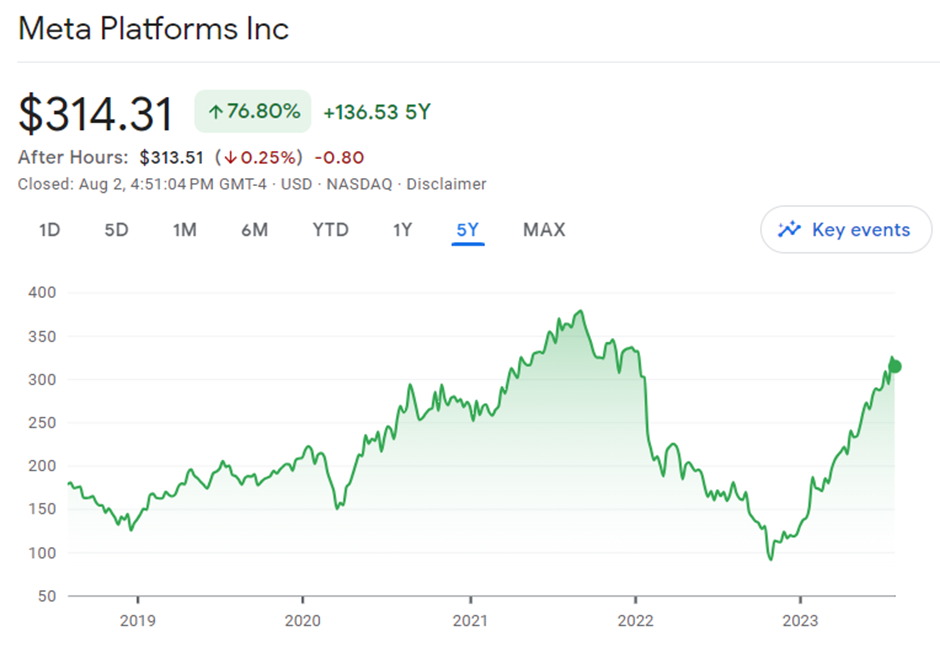
Around the time of that February report, the stock dropped 26% in a single day. That put the share price at approximately half the levels it traded at in the peak of September 2021, yet the pain wasn’t over. As the push into the Metaverse and broader Reality Labs dream continued, the share price continued to plummet. It eventually bottomed at $88, an extraordinary drop from around $380.
The problem was a combination of a sharp drop in free cash flow and a souring of public perception, although the latter is hardly anything new for Zuck and crew.
The name change to Meta had come shortly after a pivotal event: the testimony of Frances Haugen, a Facebook whistleblower, before the U.S. Senate. During her testimony, Haugen provided substantial evidence that the social media giant’s algorithms were designed to amplify divisive content, misinformation and harmful content to keep users engaged and spending more time on the platform.
Amid this mounting pressure and negative public perception, Meta’s rebranding served as a strategic move to reposition the company’s image and emphasise its focus on a “metaverse” vision. By adopting the name “Meta,” the company aimed to redirect attention away from the controversies associated with Facebook and present itself as a forward-looking, innovative tech company.
Of course, investors weren’t fooled by the idea that a simple name change would erase not only the social quandary that Facebook was in, but the group’s hellbent mission to invest in tech that nobody asked for.
With substantial shareholder pressure on the company (and of course, the helpful extreme bearishness of Jim Cramer as the world’s finest contra-indicator), Meta cut back on costs and got the core business right in the transition to Reels. The result was a massive run in the price this year, making Ghost feel good about buying the dip of all dips and saving his position in this stock.
The share price has been incredibly volatile, which is why we’ve covered the company yet again in Magic Markets Premium this week:

So, does X mark the spot?
Name changes are never spontaneous. In fact, they often follow on the heels of disaster.
When an organisation becomes associated with a catastrophic event or a major ethical breach, it can be challenging to recover public trust and salvage the brand’s reputation. In such cases, rebranding offers a way for the company to distance itself from the past, signal a fresh start, and rebuild its identity from the ground up.
Elon Musk has made no secret of the fact that he has wanted to burn Twitter to the ground from the moment he bought it. Which begs the question: is the X rebrand his way of wiping Twitter’s history off the table – or a distraction from the amount of money that the business has lost since Musk’s takeover?
Smart investors aren’t fooled by something as simple as a name change. With nearly 90 research reports on global stocks available in the library, a subscription to Magic Markets Premium for just R99/month gives you access to an exceptional knowledge base that has been built since we launched in 2021 – including our latest recap on Meta, which goes live this week.
There is no minimum monthly commitment and you can choose to access the reports in written or podcast format. Sign up here and learn how to do your own research with The Finance Ghost and Mohammed Nalla>>>