
In this week’s edition of Ghost Global, we look at two huge brands in the media and entertainment industries: Disney and Warner Music. The products and brands have been far more fun than the share prices this year!
Disney airs its dirty laundry after investors were hung out to dry
As my portfolio confirms, things haven’t been fine and dandy in the Magic Kingdom this year. After throwing the kitchen sink and Mickey’s ears at streaming in the past year and burning billions along the way, it seems that the knives came out for Bob Chapek.
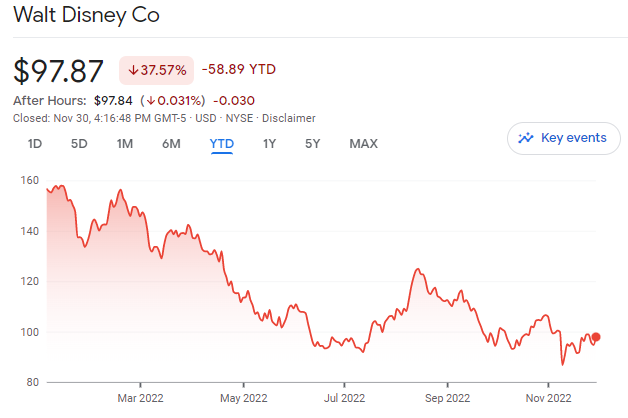
From one Bob to another, with the surprise announcement last week that Bob Iger is returning as CEO, effective immediately. This came after several Disney senior executives (including CFO Christine McCathy) informed board members that they have lost confidence in Chapek’s leadership.
Earlier this month, Chapek had announced the company’s plans of a hiring freeze, layoffs and cost cuts. It was too little, too late for the mess that had been created. Employees may have hoped that the rapid changes at the top would save them from this fate, but those dreams have been dashed. Returning CEO Iger has stated that he felt Chapek’s strategy was the “right thing to do” and that he therefore doesn’t plan to change it.
Looking at Disney’s full year earnings for the 2022 fiscal year ended 1 October 2022, there appears to be a little bit of frosting on this particular cinnamon bun. Revenue is up by 23% from last year to $82.7 billion. Net Income from continuing operations increased by 58% to $3.2 billion.
While streaming may be working out really well for Warner Music (see below), it certainly isn’t doing the same for Disney. Fortunately, the company’s Parks, Experiences and Products segment has grown revenue by 73% and operating income by a nonsensical percentage, up from $471 million to $7.9 billion. A year-on-year move like that isn’t normal obviously, but then again neither were the Covid lockdowns that killed the magic in this part of the business for many months.
Although the news of Iger’s return is probably positive overall, the share price has a lot of damage to repair. Down 38% this year, even the fairy godmother seems to have given up on turning this pumpkin into a carriage.
As for Ghost, he’s still giving the House of Mouse a chance to get it right. To find out why, you can become a Magic Markets Premium subscriber and get access to a library of research that includes reports on Disney.
Warner Music sings a happy tune
It’s safe to say that the global music industry is currently experiencing a bit of a Renaissance moment. After the introduction of the MP3 in the 90s did to record sales what Yoko Ono did to the Beatles, the industry was pummeled by internet piracy and then, climactically, a full-scale pandemic, which stopped concerts and tours overnight. Whoever decided to become a record executive between 1991 and 2021 must have possessed a special kind of clairvoyance to be able to predict that the industry would recover at all.
Here’s the unexpected upside: since the move away from physical record sales, the industry has seen a steady increase in revenue over the past six years.
How is this possible, you ask?
This sudden and rapid growth has been driven largely by the popularity of streaming services such as Spotify and Apple Music. Taking into account what a subscription to Spotify costs versus the cost of a physical album, you wouldn’t think that the math adds up.
Yet, according to recent figures, streaming services yielded a total of $13.4 billion in global revenue in 2020, making up 62.1% of the music industry’s total income. The majority of this revenue comes from paid monthly or annual subscriptions, which have seen steady growth in recent years – pandemic be damned.
Enter Warner Music Group, a shining example of the good space that music is in right now. The American entertainment company and record label conglomerate has released results for its fourth quarter and financial year ended September 2022, and there’s nothing off-key here. For the full year, total revenue rose by 11.7%, though there was an extra trading week in this period which boosted Recorded Music streaming revenue. This total revenue is split between Recorded Music, which increased by 9%, and Music Publishing, which rose by an impressive 26%. Total streaming revenue increased by 9.1%.
In Q4, revenue grew by 9% as reported and 16% in constant currency. And while advertisers are slowly starting to get the message that Gen Z are not impressed by unskippable brand messages popping up in the middle of their low-fi hip hop playlists, Warner still saw 5% growth in subscription streaming, which compensated for the decline in ad-supported streaming revenue.
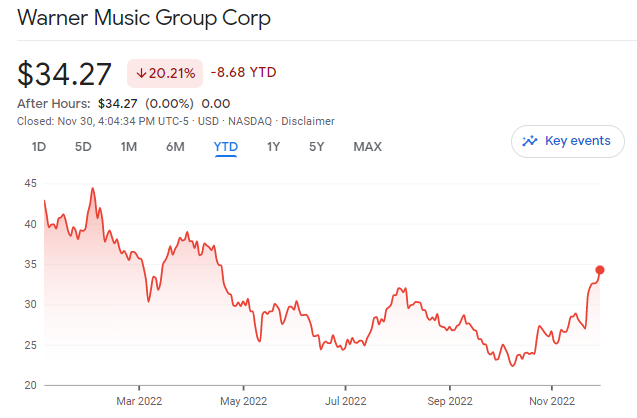
Underlying growth aside, share price performance still comes down to valuation. With a year-to-date drop of 20%, there’s no sweet melody for your portfolio here:
Warner Music has expressed intentions to focus on Eastern Europe as an area for growth in 2023 (and not because they manufacture ammunition, either). Ukraine is a mess of course, but the broader area saw an increase in music consumption of 20% in 2021 thanks to major economies like Poland. As a result, the company has put effort into intensifying its presence with investments such as Grupo Step and Big Idea in Poland, as well as Mascom Records in Serbia. The group has also launched the Out of Order label aimed at advancing artists in Europe and other emerging markets.
Every war needs a peace anthem, right?
The company will be appointing new CEO, Robert Kyncl, in January 2023. Kyncl is no stranger to streaming either, as he is currently YouTube’s Chief Business Officer. As one of the best businesses in the Alphabet (Google) stable, any experience from YouTube can only be helpful.