
The best of British and the worst of Silicon Valley. This week, the focus is on iconic British fashion group Burberry and Elon Musk’s controversial approach to his newfound ownership of Twitter.
Burberry banks on British
British luxury fashion and beauty brand Burberry has released results for the first six months of its financial year ended September 2022. Overall, the company had a very successful half-year, with revenue rising by 11% to £1.3 million and adjusted operating profit growing by 21% to £238 million.
This was largely driven by a strong performance in the retail sector, where comparable store sales were up 5% with acceleration in the second quarter vs. the first (11% vs. 1%).
During the period, Burberry focused on expanding its brand through various endeavours such as the launch campaign of its Lola handbag range. Close your eyes vegans – leather goods saw an increase in comparable sales of 11% partly thanks to this.
The company appointed CEO, Jonathan Akeroyd, in March 2022. Akeroyd has been credited with helping to revive Burberry’s fortunes by emphasising its British roots. He has also been instrumental in expanding the company’s product range and increasing its store presence in key luxury locations around the world. These factors have all contributed to Burberry’s strong growth and have positioned it well for continued success in the future.
Burberry has also appointed English fashion designer Daniel Lee as the company’s new creative director. Lee, who was previously the creative director of Italian Fashion House Bottega Veneta, will be responsible for leading the creative vision of the company in line with its vision of modern “Britishness.” In his new role, Lee will be responsible for overseeing all aspects of the brand’s creative output, from design and marketing to product development.
The company has placed a strong focus on achieving top-line growth in recent years. This is evidenced by their aggressive expansion plans and target of £4 billion in revenue within the next 3-5 years. This target is even more ambitious when considering their long-term goal of £5 billion in revenue. It goes to show that the world may have mixed feelings about the Royal House of Windsor, but when it comes to the House of Burberry, things are looking up.
Elon Musk flips the bird
When a company acquisition is formalised by the new owner walking into headquarters carrying a porcelain sink and captioning the resultant tweet “let that sink in”, you know everyone is bound to get nervous.
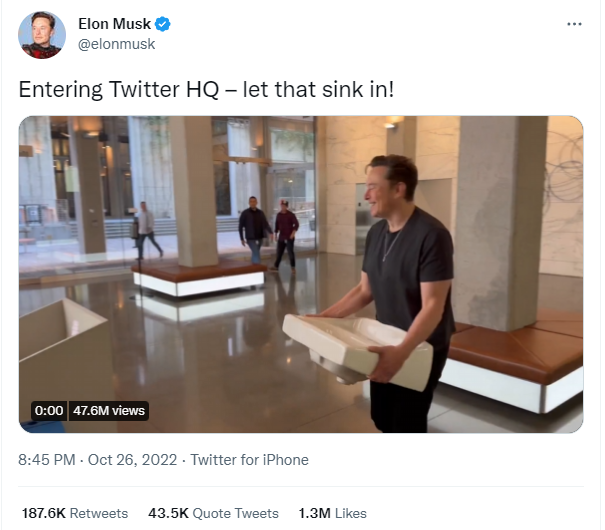
Ever the showman, Elon Musk has provided the world at large with Days of Our Lives-level drama in his quest to own Twitter – and he doesn’t seem to be slowing down now that he holds the reins. With mass layoffs and controversial changes to the platform being implemented, this past week has been a tumultuous one for the digital soapbox, and the effects are starting to show.
Reports suggest that about a third of Twitter’s Top 100 marketers have not advertised on the social media platform in the past two weeks, presumably concerned about brand association.
Twitter is a platform that relies heavily on advertising for its revenue. In recent years, Twitter has tried to find other sources of revenue, such as subscriptions, but those products have not gained much traction, like Elon’s nosediving paid Blue Tick concept, which allowed people to go wild with pretending to be George Bush (blue tick and all) while tweeting about Iraq.
Twitter’s lack of diversification in its revenue sources could become a serious problem if advertising revenue continues to decrease in the future.
Of course, revenue may not matter at all if there is no-one left in the office to actually keep the platform running. At the moment, about 5 000 employees have either been laid off or have quit since Musk’s hostile takeover. To put that number in perspective: that’s over half of the company’s global workforce. And it’s not just the seat-warmers that are packing up their pot plants. Included in the employees who have resigned are a number of top executives, notably the Head of Integrity and Safety Yoel Roth, Chief Private Officer Damien Kieran and Chief Information Officer Lea Kissner.
Notably, with all these executives, Twitter never managed to eradicate child porn on the platform. Under Musk, it was sorted out within days. I’m no fan of Musk but there’s no disputing that something was very wrong in blue bird world.
Unsurprisingly, all of this commotion has resulted in lawsuits being filed against Twitter. These include alleged violations of the California WARN Act and the Americans with Disability Act. This came after Musk’s announcement that the majority of employees would need to work out of the office for at least 40 hours per week, making it infeasible for many employees with disabilities to continue their jobs.
Looking through the noise, is it all bad?
Breaking labour law is never ok and those lawsuits need to play out in court with compensation for those who deserve it. But if we look at the bigger picture here, Musk is proving that Big Tech has been fat and happy for far too long. Many times, investors have felt their blood boil at the news of another 20% increase in headcount when revenue is barely moving forward. Musk is staging a revolution in Silicon Valley and investors aren’t complaining, with tech layoffs now spreading across the industry.
A cursory flick through the complaints by ex-staff members at Twitter will reveal exactly what was wrong with this industry. While the investment bankers are working 12 hour days (and longer) for their big salaries and bonuses, many in Silicon Valley were goofing off on TikTok and worrying more about pointless committees than getting any work done.
If you don’t believe me, just consider that Twitter is still doing just fine and most of the staff are gone.
The biggest question is around revenue. A company can’t shrink its way into profitability if all the advertisers leave. Personally, whilst I doubt that Twitter will go down as a great investment for Musk, I reckon it will be OK. Most of all, I think it’s the wind of change that tech investors so desperately needed to feel blowing.
If you want to understand more about the issues that have been plaguing the tech industry, Magic Markets Premium has an extensive library of research on this sector. You can get access to research on Apple, Amazon, Meta, Microsoft, Intuit and so many others for R99/month or R990/year.