
Banking, sport, fashion and software. Ghost Grads Kreeti Panday and Sinawo Bikitsha bring us a great selection of updates in this week’s edition of Ghost Global.
Barclays sued over paperwork errors
British bank Barclays Plc has been sued by its shareholders who claim that they were defrauded by the executives regarding the accidental total sale of $17.6 billion more debt than regulators had allowed. The argument is that this is such a breach of internal controls that it is “deliberately reckless” – ouch!
Described as “bizarre” by some analysts and “embarrassing” by others, this mistake by Barclays has led to two Florida pension funds filing a complaint in the US District Court in Manhattan.
It does seem extraordinary that a bank can issue $36 billion in securities after registering with US regulators to only sell up to $20.8 billion in August 2019. There was a subsequent issuance as well, just making the situation worse.
Barclays will be buying back the excess securities and will now need to defend claims in court as well. The last thing shareholders want is management to be distracted, as recent results really weren’t great and things are just getting worse in the UK market.
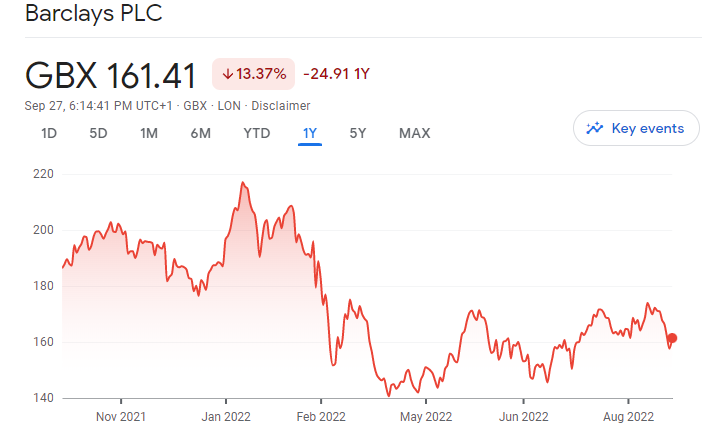
The share price is down 13.4% this year:
Manchester United plc: rather be a footballer than a shareholder
Harry Maguire’s performance isn’t the kind of performance we are focusing on here. Manchester United plc is a listed company and has released results for the year ended June 2022.
Despite record revenue of £583 million (helped along by record tour revenues in a post-pandemic recovery), the net loss for the year worsened by 25.3% to a record £116 million. One has to wonder how these sports teams ever make money, as these losses are against a backdrop of a season ticket waiting list of over 135,000 people. Interestingly, ticket demand for women’s matches increased by 55%.
In digital products and experiences, the club’s online store (United Direct) saw an increase in website traffic of 73%. eCommerce sales almost doubled from FY21.
So, with all this good news, why the net loss?
Operating expenses rose by 28.6% to £692.6 million. We all know that footballers are paid insane amounts of money. Employee benefit expenses (i.e. wages) increased by 19.1% to £384.2 million, attributed to the six acquisitions for the first team playing squad. This includes a contract signed with Portuguese footballer, Cristiano Ronaldo, which results an annual wage of approximately £25 million. Manchester United has a higher wage bill than any other Premier League club.
Clearly, it’s better to be a footballer than a shareholder in the club.
Manchester United’s net debt stands at £514.9 million, a 22.7% increase primarily attributed to the weakening of the pound against the dollar. Yes, to add to the challenges, there are dollar borrowings.
The club expects decreased spending in the next financial year.
Ralph Lauren has repositioned as a luxury brand
American fashion group, Ralph Lauren Corporation, used its 2022 Investor Day to declare its “reset” to be complete. This is based on a claim that 74% of consumers consider Ralph Lauren to be a luxury brand.
The group has added over 20 million customers to its direct-to-consumer channels over the last 4 years. These customers are believed to be younger and higher value consumers who are willing to buy more goods at full price, giving the group more pricing power. eCommerce operations now represent over a quarter of sales, which the group aims to grow by 400 basis points by FY25.
The group has exited two-thirds of its wholesale stores in North America and plans to open over 250 full price stores worldwide over the next three years, once again putting emphasis on full price consumers.
The group has noted that its greatest opportunity for market growth lies in women. Womenswear currently makes up 30% of the business, yet 56% of consumers are women. The group aims to focus on its product offering for women in order to grow this market, encouraging women to shop for their partners and children as well.
The group also expects that by 2025, Gen Z and millennials will contribute approximately 70% of the luxury goods market. It has focused on gaining this market through increased activity on social media and gaming platforms. As a Gen Z’er herself, Kreeti reckons she will still be in the 30% by 2025!
If you want to learn more about luxury goods, the Magic Markets Premium library includes a report on luxury goods platform Farfetch.
Salesforce to integrate with WhatsApp
It’s been a month since Salesforce released Q2 earnings. For the three months to July, revenue was up 22% to $7.7 billion and operating margin dropped to 2.5%.
In that month, the share price has decreased by around 8%.
The latest news is that Meta CEO Mark Zuckerberg has announced that WhatsApp is partnering up with Salesforce, reflecting a consumer preference to communicate with businesses over text. Indeed, that’s got to be better than invasive phone calls.
L’Oréal Group and its brands have already considered being the pilot of this integration, by using WhatsApp to reconnect with customers to send them coupons, offers and reminders of items left in a shopping cart.
Salesforce plans to hit sales of $50 billion by 2025 with a 25% operating margin a year later. That will need more than just a WhatsApp integration to achieve.