
We all know that it’s practically impossible to only buy what you actually went to Dis-Chem for. There are many things about the pharmacy group that most people don’t know, so Ghost Grad Karel Zowitsky took a closer look.
Dis-Chem listed in 2016 at a valuation that was simply far too high, so investors suffered years of disappointment.
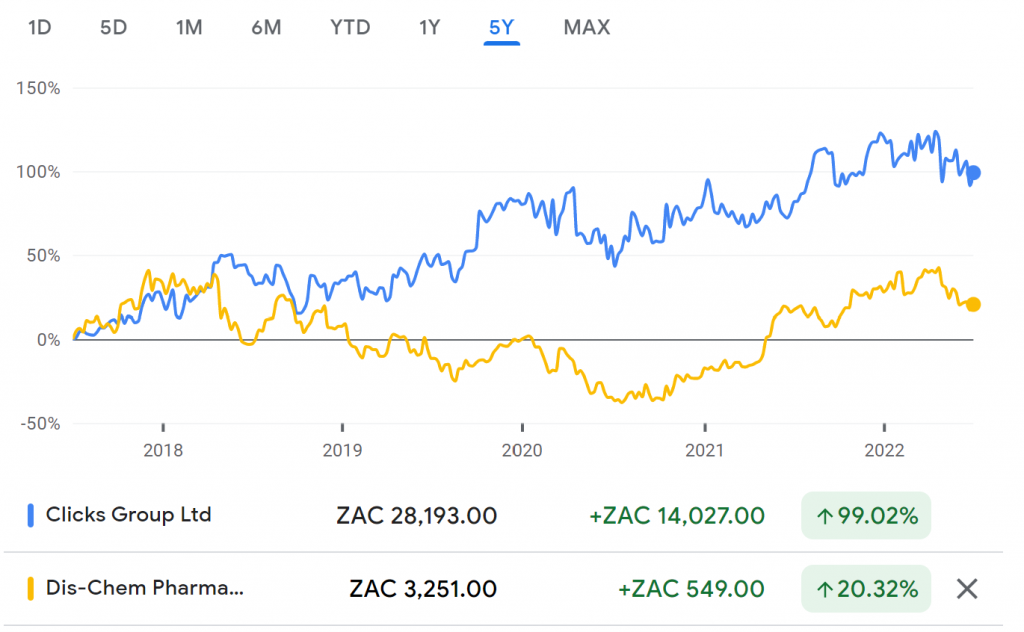
The recent story looks a little different, with the share price trading 20% higher than the levels at the start of 2020.
To show you how important it is to avoid frothy IPOs (new listings), here’s a chart of Dis-Chem vs. Clicks over the past five years:
Dis-Chem recently released its integrated annual report along with the audited annual financial statements for the year ended 28 February 2022. This typically doesn’t give any new price sensitive information, as the results are announced earlier than the release of full reports. For those willing to dig deeper and learn about the company, there are usually some interesting nuggets that can help flesh out an investment thesis (or give you more reasons to avoid the company).
It’s a bit like shopping at Dis-Chem – the more you look, the more you find!
The underlying numbers look good for the latest financial year. Revenue grew by 15.7% to breach the R30 billion mark for the first time in the group’s history and operating profit grew by 21.6%.

Let’s take a deeper look at the business.
Pharmacy-first approach
It’s important to understand that Dis-Chem believes in a pharmacy-first approach. This strategy ensures that there is a dispensary in every store along with the front shop. Conversely, Clicks was a health and beauty retailer that subsequently added pharmacies to the stores, so the DNA of the groups is different.
The dispensary is the biggest driver of footfall, with more than 2.6 million scripts filled in an average month. This is not the main driver of profit, as dispensed medicine has a regulated Single Exit Price that doesn’t provide the juiciest of margins, making Dis-Chem reliant on the front shop (the rest of the store) to achieve a healthy gross margin overall.
The exact same strategy applies to Clicks and even the little pharmacy up the road from you.
To make the economics even trickier, pharmacists are the highest earners among customer-facing retail store staff – and by a significant margin. The combination of low-margin products and expensive staff is why pharmacist groups try everything possible to optimise store schedules. If you’ve ever wondered why you sometimes wait 30 minutes in a queue for a pharmacist, now you know.
The reason you struggle to go into Dis-Chem for “just one thing” is because the store is designed that way. The idea is to tempt you en route to the dispensary with all the front shop items. Now you also know why the dispensary is always furthest from the entrance!
Organic products and inorganic growth
When a company is following an “inorganic” growth strategy, it is growing through acquisitions. This is what sets Dis-Chem apart at the moment, as competitor Clicks is following more of an organic growth path while experimenting with new things, like a dedicated baby store format.
If we turn the clock back a bit, we find an acquisition that was a clear show of strategic intent by Dis-Chem. The Baby City acquisition (at a ticket price of R430 million) became effective on 1st January 2021. A quick walk around the store is a great way to delay any plans to have a baby, as the costs of having a little person are incredible. My mother can wait longer to become a grandma! (note from The Ghost – as the parent of a toddler, I can confirm this!)
Baby City is a strong business with a solid footprint and reputation among parents. A key benefit of the Dis-Chem acquisition is that the Dis-Chem loyalty programme can now apply at Baby City as well. The financial pressures of having a baby are significant and parents tend to look for every saving opportunity.
Integrated reports tend to provide plenty of information about stakeholders like the community, so it’s worth mentioning that the Dis-Chem Foundation is a beneficiary of the loyalty programme. The Foundation has been around since 2006 and a portion of the purchase value each time a card is swiped is donated to it, providing funding for projects that provide people with water, food, shelter, and warmth.
Moving on, October 2021 saw Dis-Chem seal the deal on Pure Pharmacy Holdings (trading as Medicare Health) by acquiring 100% of the outstanding share capital for R282 million. The acquisition provides control over 48 Medicare stores, which are now being rebranded into Dis-Chem stores, giving a healthy boost to Dis-Chem’s footprint with an additional 17,721m² of floor space. Importantly, this gives Dis-Chem access to areas in which it was previously under-represented.
It is difficult to grow a pharmacy footprint organically, as obtaining regulatory approvals to open a pharmacy is a lengthy and tricky process. This is the main reason why South Africa still has many independent pharmacies. An acquisition of a chain of pharmacies is gold for the likes of Dis-Chem, with a few hoops to jump through along the way with the Competition Commission.
In November 2021, Dis-Chem acquired 25% of the issued share capital in Kaelo for R192 million, a group that owns AskNelson (a psychological wellbeing platform often utilised by organisations to provide support for their staff), occupational health clinics as well as gap and primary health insurance products.
This acquisition solidified an interesting partnership between Dis-Chem and Kaelo that saw the launch of Dis-Chem Health, a provider of three products: primary healthcare insurance, gap cover, and accident cover. The group notes that there are currently 12.4 million employed, yet not medically insured people in South Africa, which provides a strong case for affordable medical insurance.

Well written and very informative article, Karel! Well done and thank you for great insights!
Appreciate the focus is on the business franchise and not analytics. So, I am interested in management control over all the takeovers being up to speed?
Hi Wayne – I think what you’re asking is whether they are successfully integrating the businesses? Difficult to know based on public documents sadly! The answer (either way) will lie in the next few results.