
Absa gives us more banking insights

Absa has released a trading update for the five months to May 2022 as well as a trading statement dealing with the six months ending June 2022. The banks have been stellar performers this year in a market that has inflicted pain on most people.

Regular readers of Ghost Mail will know that I’ve been talking about the banks quite a bit this year. With rising rates and demand for credit from both consumers and businesses, it’s an environment in which the banks tend to shine.

The bank share prices tend to be highly correlated when it comes to short-term moves, as they are impacted by similar macroeconomic realities. They may move together, but that doesn’t mean they have moved to the same extent this year.

Here’s a chart explaining what that looks like (note the gap between Nedbank and Capitec, despite the waves typically rising and falling together):
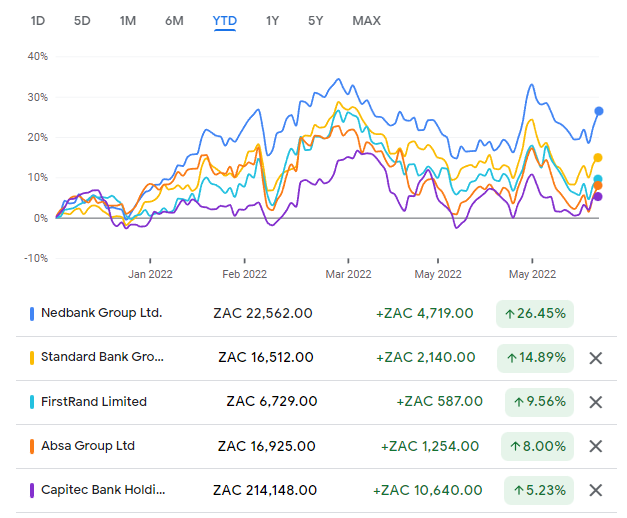
I must say, when I wrote on the banks just a few weeks ago, the share price gains looked a lot better in a similar chart.

In the Absa update, the bank notes that demand for customer loans was high single digits, with improved growth in the Corporate and Investment Banking (CIB) division. There was similar growth in Retail and Business Banking (RBB), which is driven by demand for home loans and vehicle and asset finance.

Customer deposit growth slowed to mid-single digits, with Absa noting that this was driven by a reduction in low-margin national government deposits. Deposit growth in the RBB division has been described as “solid” which is too vague to really give us insights.

Keep an eye on RBB customer deposit growth this year. People are saving less and spending more in my view, no doubt a function of the cost-push inflationary environment we find ourselves in. It’s good for banks when consumers are buying assets and bad for banks when they are buying petrol and food instead, as this lowers the credit quality of the average borrower. Absa hasn’t included any specific commentary on this – it is just common sense.

Revenue growth for the five months looks good, up by low double digits. This was driven by net interest income (which benefits from higher rates and loan growth) and non-interest income (assisted by a rebound in life insurance revenue and decent growth in fee and commission income as well as trading revenues).

This strong revenue growth resulted in improved margins. The bank talks about positive JAWS, which means income growth exceeded growth in operating expenses. The cost-to-income ratio improved to the low 50s.

Pre-provision profit over the five months grew by mid-teens. Below that, the bad news is that “credit impairments grew materially” though this was off a relatively low base. The credit loss ratio is above the through-the-cycle target range of 75 to 100 basis points.

Inflation is starting to bite I think, visible in higher vehicle and asset finance credit impairments. Be careful here – when the banks tighten up on lending for vehicle finance, the incredible numbers we’ve seen from car dealership businesses will falter.

On the plus side, the impairments in CIB decreased materially. Absa’s models are suggesting that companies are a lot better off than consumers at the moment.

Return on equity for the period has improved to almost 17% which is really good. To sweeten this deal even further for investors, the dividend payout ratio will increase from 30% to 50% as the core equity tier 1 ratio is very strong at 12.5%. Simply, this means that the bank’s balance sheet can easily support a higher dividend.

Normalised headline earnings per share (HEPS) for the six-month period will be at least 20% higher than the 1,019.7 cents in the first half of 2021.

The net asset value per share at the end of 2021 was R149. The share price is trading around R169, which is a 13.4% premium to a number that is nearly six months out of date and would’ve grown accordingly, as this has been a strong period for the business.

We will only know once June results are released, but I would guess that the current price is probably at or slightly above the 1H22 NAV per share.

With return on equity of 17% (well above the cost of equity in South Africa), this creates an argument that Absa may be undervalued. The risks lie in overall consumer health, particularly if inflation drags spending away from durable assets and into the basics, like food and fuel.

Leave a reply

Please enter your comment!
Please enter your name here

Latest Articles

Boring business billions

The world’s richest people aren’t always building apps or chasing disruption. Here are three stories that reveal how unglamorous industries keep minting billionaires. From billboards to pig farming and car mats, there are many ways to make it big.

Ghost Bites (AB InBev | Jubilee Metals | HCI | Schroder European Real Estate)

With all the news from the first week of January 2026 included in one Ghost Bites, you'll find deal news at AB InBev, Jubilee Metals and HCI. There's also a valuation update at Schroder European Real Estate.

Why ETFs Play a Vital Role in Private Markets

Exchange Traded Funds (ETFs) have emerged as a transformative solution, for public markets and also as a strategic bridge to private market exposure. The border between traditional and alternative asset management is dissolving. Clients are driving the convergence, seeking integrated solutions that blend public and private exposures. Duma Mxenge of Satrix explains.

Ghost Bites (AfroCentric | Aspen | Novus – Mustek)

Aspen announced the disposal of Aspen APAC and the market loved it. AfroCentric is disposing of Activo and the market forgot to notice - for now, at least. And for Novus, a purchase of 3,000 shares has turned out to be very expensive in the Mustek deal.

UNLOCK THE STOCK: Southern Sun

In the 65th edition of Unlock the Stock, Southern Sun joined the platform to talk about the recent numbers and the strategic outlook for the business.

Ghost Bites (Mr Price | NEPI Rockcastle)

Mr Price isn't backing off on the NKD deal, despite the absolute hatred for the transaction from the market. NEPI's pre-close update shows the importance of looking at per-share growth.

Sponsored

Ghost Stories #89: 25 years of Satrix – how indexation changed investing in South Africa

In the year 2000, a lot happened. There was some questionable pop music. There was also the Dot-Com Crisis, followed by a period that saw incredible equity returns in South Africa until the Global Financial Crisis hit in 2007/2008. And during that important period in our local market, we also saw the emergence and initial growth of ETFs in South Africa, spearheaded by Satrix. To reflect on 25 years of ETFs in South Africa, René Basson joined me to share the important milestones and fascinating stories that defined this journey. Join us as we look back on how Satrix made it possible for everyone to own the market.

The Finance Ghost Plugged in with Capitec: Ep 6 (Noodles without borders – bringing miso to Mzansi)

Lu-ise Hattingh and Ruan Botha are a great example of the power and value of travel. After spending time in Japan, they fell in love with the culture and food. As all great entrepreneurs do, they also took the opportunity to learn about the Japanese approach to consumer brands. That curiosity eventually sparked a business idea they brought back home. Today, Lu-ise and Ruan are rolling out Market Kokoro franchise stores in South Africa.

Ghost Stories #88: Cell C – more than just an MVNO engine

Cell C has been on quite the adventure in its efforts to carve out a sustainable competitive position. Cell C has created a profitable business model that goes well beyond the MVNO operations that the market tends to focus on. In this podcast, CEO Jorge Mendes joined me to explain Cell C's business and how they plan to win across key verticals.

Ghost Stories #87: Lessons from 2025 – discipline over drama

As we look back on a fascinating year in the markets, Nico Katzke (Head of Portfolio Solutions at Satrix) delivered a fantastic mix of insights on this podcast that can be applied to your strategy in 2026 and beyond. From being careful not to learn the wrong lessons through to choosing simplicity over complexity, there's a lot of great stuff in here to get you ready for another year in the markets.