
This week, Ghost Grads Kayla Soni and Sinawo Bikitsha got their investment passports stamped and looked abroad to the latest company news from the US.
Amazon has more legal drama
Amazon is on the receiving end of a lawsuit yet again.
This time, it has been filed by California Attorney General Rob Banta, accusing the e-commerce giant of a pricing strategy that is unfair to merchants and artificially keeps prices higher for consumers. Although the lawsuit is limited to California, there is potential for it to have an impact across the US.
Antitrust laws protect and promote competition for the benefit of consumers, as this helps drive efficiencies in the market and avoids a scenario where market power is abused through unjustifiably high prices, especially on important goods. The California case argues that Amazon is coercing sellers into a price war that only Amazon can win.
According to the claims brought against Amazon, the company penalizes its sellers for charging lower prices on other websites. If Amazon notices that the price is cheaper somewhere else, then it removes critical buttons like “Buy Now and “Add to Cart” or demotes it in search results.
The net result of this behaviour? The prices end up being similar on all sites, which stifles competition. This is similar to Amazon setting a price floor for the goods.
Amazon has successfully defended this before in the District of Columbia. The winning argument was that Amazon’s low-price mandate actually brings down the prices for goods sold online, which benefits consumers.
This certainly isn’t the first time that Amazon has gotten itself into hot water. In 2020, the European Commission went after Amazon for using data to unfairly compete with marketplace sellers. After a lengthy investigation, the company made changes to its practices in July 2022.
Amazon’s share price has lost 28% of its value this year. It is trading at similar levels to May 2020.
FedEx’s pandemic gains are gone
The Finance Ghost and Mohammed Nalla have previously covered FedEx in Magic Markets Premium and their fears were warranted – the company’s gains during the pandemic have evaporated. The share price chart is extraordinary:
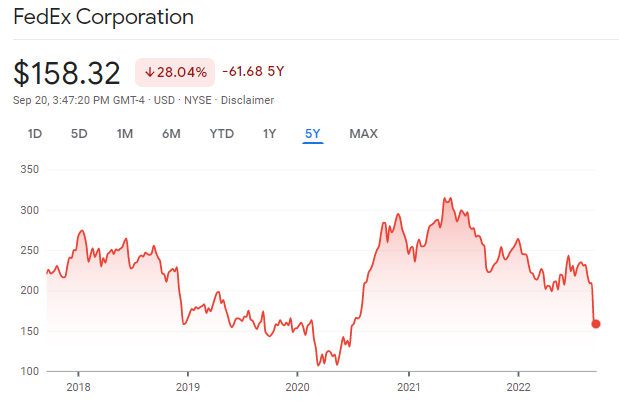
FedEx gave its investors an unpleasant surprise on Thursday by announcing its fourth quarter results sooner than expected. Recently appointed CEO Raj Subramaniam warned that global shipping volumes “significantly worsened” and are likely to cause a shortfall of $500 million in its revenue target.
FedEx’s announcement caused a capitulation in the share price, dropping by more than 25%.
Whilst total revenue increased by 8% year-over-year, international airfreight revenue decreased by 12% year-over-year and international domestic package revenue decreased by 10% year-over-year, corroborating the CEO’s statement. Net profit margin collapsed as inflationary pressures hit the business, particularly in fuel price pressures.
A Yahoo Finance report quotes analysts from Deutsche Bank as saying that this is the weakest set of results they’ve seen relative to expectations in their 20 years of analysing companies. With plans to cut flights, reduce labour hours and close more than 90 of the 2,200 office locations, the pandemic honeymoon is over for FedEx.
Netflix on the rise
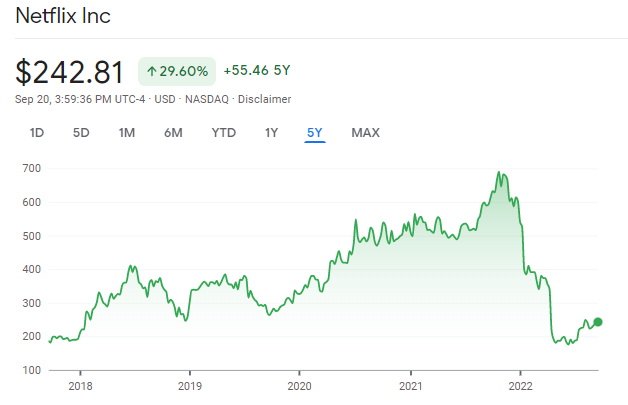
Netflix shares climbed roughly 7% last week after a bullish Wall Street analyst, Mark Mahaney, gave out some positive comments on the streaming platform’s opportunities. This is a nice change of pace compared to some of the carnage we’ve seen in the US market.
The upgrade to a “buy” rating was based on the upcoming ad-supported subscription plans and efforts to end password sharing. With a plateau in subscriber numbers, it is critical to improve the revenue from each existing subscriber. The share price is up 39% over the past three months and is trading at a significant forward P/E multiple of over 25x, so earnings growth needs to come into play.
Will the plans be enough? Advertising is estimated to contribute around $2 billion in incremental revenue and the successful end of password sharing could bring another $500 million to $1 billion.
Third quarter earnings will be released in October and management predicts a million net new subscribers, which would be its first gain since the final quarter of 2021. Given the recent share price momentum, any disappointments are likely to be punished.
The Netflix share price chart is incredible:
Roblox’s valuation looks vulnerable
American video game developer Roblox suffered a 13.2% fall in share price after its investor day and release of August metrics.
Clearly, the professional investors are skeptical of growth initiatives and some of the new features the company has put forward, like new animated avatars that use real-time facial tracking and user voices. There are concerns over whether Roblox’s game engine will retain older and wealthier users, which may explain the current trend in user engagement vs. spending.
Despite a solid increase in daily active users in August, “bookings” dipped during the back-to-school season. Simply, users are playing more and spending less. Inflation can’t be helping the situation.
The problem lies in the Price/Revenue multiple of over 10x, which is enormous in any environment and especially in this one. With any jitters over growth, these multiples can quickly unwind.
Just ask Netflix.
Roblox is looking to enhance its revenue from advertising. With an increasingly worrying macro picture forming, it may be too late to try and tap into advertising spend.
Interested in global stocks? Not sure how to do your own research, or looking to supplement your own process? The Finance Ghost and Mohammed Nalla release a weekly podcast and report on global stocks, available for R99/month or R990/year in Magic Markets Premium. The full library is available, giving you over 45 reports to enjoy!