
July sales data: all about the base

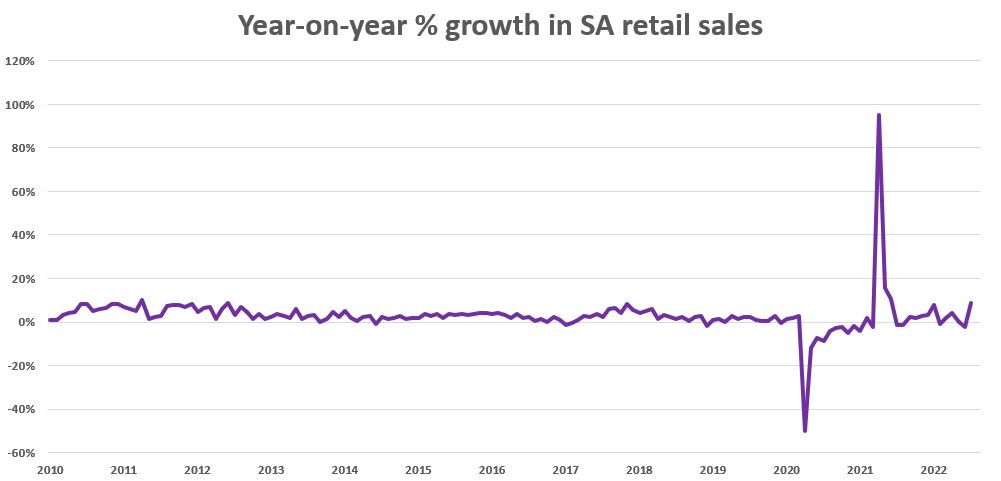
The July 2022 retail sales data from Stats SA reflects the distortion of the terrible riots in 2021. Chris Gilmour demonstrates how erratic the data has been over the pandemic vs. longer-term averages.

When I saw the July 2022 retail sales update from Stats SA, I was somewhat taken aback to put it mildly. For the month as a whole, year-on-year percentage change at constant 2019 prices was 8.6%. Not –8.6% as it could well have been, all other things being equal. But a positive 8.6%.

After a few minutes it became clear that I was dealing with a major base effect anomaly and rationalising what happened in July 2021, the penny dropped. A year earlier, the riots in KZN and parts of Gauteng had created havoc with retail sales, creating a very low base of comparison for the July 2022 figures.
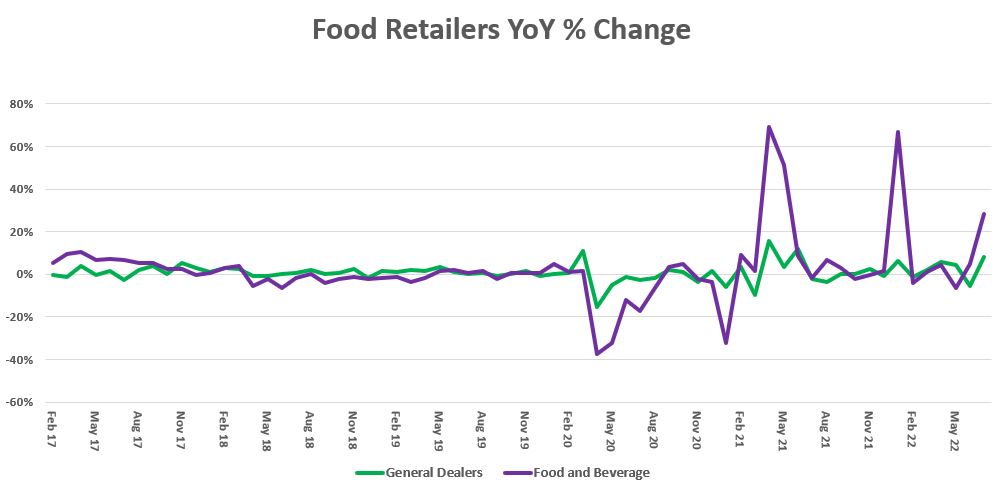
This shows up in different ways in the statistics. So for example, growth in sales at general dealers (supermarkets in the main) was a strong 8.2%. But that was nothing in comparison with sales growth at the smaller traders, categorised as “Food, beverages & tobacco in specialised stores” – that rose by a whopping 28.5%! Small traders probably bore the brunt of last year’s riots and happily they have largely come back with a vengeance.

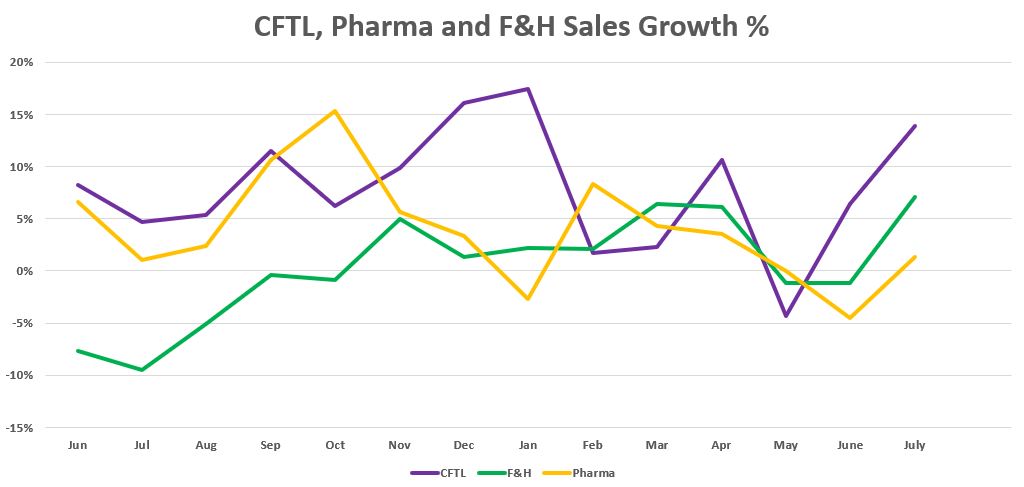
Clothing, Footwear, Textiles & Leather (CFTL) sales rose by a very strong 13.9% year on year and Household Furniture, Appliances & Equipment (F&H) sales rose by 7.1%. The looters obviously weren’t overly interested in pharmacy and cosmetic items, as they only rose by 1.3% year on year and of course DIY stores weren’t in demand by the plunderers at all, continuing their dismal decline year-on-year, with another negative print of -3%.

The following graph shows the time series of sales growth for general dealers and specialised food retailers going back five years. The two spikes in April 2020 and January 2022 were both pandemic-related and both resulted from base effects. This most recent spike will most likely be followed by a noticeable contraction the following month.
The following chart shows the time series for a couple of discretionary categories (CFTL and F&H), plus a typically stable category, Pharmaceuticals. Ceteris paribus, they should both be in steep decline by now as the impact of higher interest rates kicks in. But the July 2021 base effect is obviously distorting both. As with the previous graph, we should expect the August sales figures to exhibit a contraction in growth.
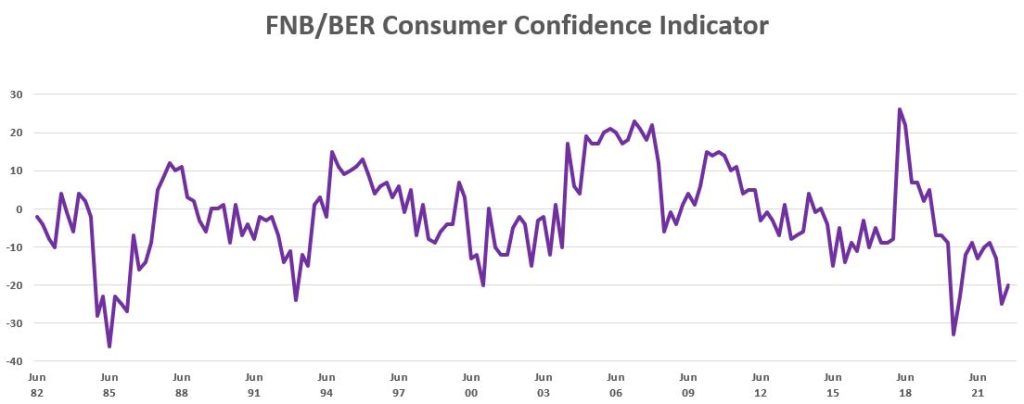
Finally, the BER/FNB Consumer Confidence Indicator. This is updated for Q3 and shows a slight improvement following the sharp deterioration in Q2. However, it is still at multi-decade lows and reflects extremely depressed consumer spending:
SARB’s MPC will give its repo rate decision next Thursday September 22 where it is widely expected that the repo rate will rise by another 75 basis point to 6.25%. Ultimately this will have a further dampening effect on consumer spending.

For equity research on South African retail and other stocks, go to www.gilmour-research.co.za.

3 comments

Leave a reply

Please enter your comment!
Please enter your name here

Latest Articles

Boring business billions

The world’s richest people aren’t always building apps or chasing disruption. Here are three stories that reveal how unglamorous industries keep minting billionaires. From billboards to pig farming and car mats, there are many ways to make it big.

Ghost Bites (AB InBev | Jubilee Metals | HCI | Schroder European Real Estate)

With all the news from the first week of January 2026 included in one Ghost Bites, you'll find deal news at AB InBev, Jubilee Metals and HCI. There's also a valuation update at Schroder European Real Estate.

Why ETFs Play a Vital Role in Private Markets

Exchange Traded Funds (ETFs) have emerged as a transformative solution, for public markets and also as a strategic bridge to private market exposure. The border between traditional and alternative asset management is dissolving. Clients are driving the convergence, seeking integrated solutions that blend public and private exposures. Duma Mxenge of Satrix explains.

Ghost Bites (AfroCentric | Aspen | Novus – Mustek)

Aspen announced the disposal of Aspen APAC and the market loved it. AfroCentric is disposing of Activo and the market forgot to notice - for now, at least. And for Novus, a purchase of 3,000 shares has turned out to be very expensive in the Mustek deal.

UNLOCK THE STOCK: Southern Sun

In the 65th edition of Unlock the Stock, Southern Sun joined the platform to talk about the recent numbers and the strategic outlook for the business.

Ghost Bites (Mr Price | NEPI Rockcastle)

Mr Price isn't backing off on the NKD deal, despite the absolute hatred for the transaction from the market. NEPI's pre-close update shows the importance of looking at per-share growth.

Sponsored

Ghost Stories #89: 25 years of Satrix – how indexation changed investing in South Africa

In the year 2000, a lot happened. There was some questionable pop music. There was also the Dot-Com Crisis, followed by a period that saw incredible equity returns in South Africa until the Global Financial Crisis hit in 2007/2008. And during that important period in our local market, we also saw the emergence and initial growth of ETFs in South Africa, spearheaded by Satrix. To reflect on 25 years of ETFs in South Africa, René Basson joined me to share the important milestones and fascinating stories that defined this journey. Join us as we look back on how Satrix made it possible for everyone to own the market.

The Finance Ghost Plugged in with Capitec: Ep 6 (Noodles without borders – bringing miso to Mzansi)

Lu-ise Hattingh and Ruan Botha are a great example of the power and value of travel. After spending time in Japan, they fell in love with the culture and food. As all great entrepreneurs do, they also took the opportunity to learn about the Japanese approach to consumer brands. That curiosity eventually sparked a business idea they brought back home. Today, Lu-ise and Ruan are rolling out Market Kokoro franchise stores in South Africa.

Ghost Stories #88: Cell C – more than just an MVNO engine

Cell C has been on quite the adventure in its efforts to carve out a sustainable competitive position. Cell C has created a profitable business model that goes well beyond the MVNO operations that the market tends to focus on. In this podcast, CEO Jorge Mendes joined me to explain Cell C's business and how they plan to win across key verticals.

Ghost Stories #87: Lessons from 2025 – discipline over drama

As we look back on a fascinating year in the markets, Nico Katzke (Head of Portfolio Solutions at Satrix) delivered a fantastic mix of insights on this podcast that can be applied to your strategy in 2026 and beyond. From being careful not to learn the wrong lessons through to choosing simplicity over complexity, there's a lot of great stuff in here to get you ready for another year in the markets.