Three well-known South African retailers released results to the end of June last week: Woolworths and Truworths with their year-end figures and Massmart with their interim results. Chris Gilmour digs in.
All three companies used to be part of the same grouping (the greater Wooltru group) in the 1990s, but have operated as separate entities for many years now. Massmart is a retailing conglomerate, with an emphasis on general merchandise. Truworths is the leading credit-oriented clothing retailer in South Africa. Woolworths is a hybrid of upmarket food and quasi department-store clothing in South Africa and with significant investments in Australia.
The results differed markedly, from the downright shocking at Massmart, through what is seemingly a turnaround at Woolies to the record results from Truworths. And yet in all of these results, it was what WASN’T said at the presentations that was far more interesting than the actual content itself.
Walmart springs a surprise
The poor Massmart results had been widely telegraphed in a trading update some weeks earlier, so they came as no surprise. What did shock the market, however, was the announcement that controlling shareholder Walwart was making an offer to buy out the minorities at a significant premium to the prevailing share price.
What happens to Massmart after it has been delisted is anyone’s guess. Walmart may decide to keep it in unlisted form and make the necessary changes to effect the turnaround strategy. Alternatively, it may get sold off in whole or in part.
WalMart doesn’t have a great track record of investment outside of north America. It persevered with Asda in the UK before limping away from it after being paid roughly what they paid for it twenty years earlier. It never managed to gain critical mass in Brazil or Germany and has also exited South Korea and Japan in recent times.
To maintain a presence in South Africa makes little sense, in my opinion. Long gone are the days when Massmart was set to become the largest retailer in Africa, using SA as its base. Like many other SA retailers, Massmart has progressively been reducing its non-RSA footprint on the continent. Having a physical presence in SA is likely to just be a distraction for Walmart management and any revenues and profits it might make in future wouldn’t amount to more than rounding errors in Walmart’s grand scheme of things.
Woolworths is clawing its way back
Woolies came out with their full year results on August 31 and, like the curate’s egg, it was good in parts. But not good enough to really make the market sit up and take notice. Woolies has been damaged in the past 25 years by successive forays into Australia and especially its acquisition of department store chain David Jones.
Its first acquisition, in 1997, was the thirty-something chain called Country Road. This was a quintessentially Australian operation that sold relatively high-quality merchandise at relatively elevated price points. It was in quite a different niche to Woolies in SA, but it was also a chain in transition. Country Road’s customer base was changing and Country Road wasn’t changing with it. The company went through a lot of pain until a Scotto/Australian by the name of Ian Moir rescued it.
For his efforts, Moir was rewarded with the top job as CEO of Woolies and to begin with, he hardly put a foot wrong. But then, as is often the case, he got too big for his boots and decided it would be a good idea for Woolies to become the pre-eminent department store chain in the southern hemisphere. Because of Moir’s success with Country Road, the Woolies board backed him fully with the acquisition of David Jones. He had grandiose plans for the chain, including selling Woolies Foods through the department stores. Of course it all came to nought, Woolies got themselves into big trouble and Moir did a leopard crawl out of the organisation in 2019.
It was left to present incumbent Roy Bagattini, formerly an SAB Miller and Levi Strauss executive, to pull the fat out of the fire with David Jones. And to be fair to Bagattini and CFO Reeza Isaacs, much has been achieved since Moir left. The balance sheet is in much better shape, R1.5 billion has been repatriated from David Jones to South Africa and Australia appears to have been stabilised.
But the real jewel in the crown – Woolies Foods – is taking major strain and is losing market share to arch-rival Checkers. Bagattini went to great lengths in the presentation to emphasise that Woolies Foods isn’t just about price; it’s about value. And he’s right. This isn’t just semantics. Almost 2/3 of Woolies Foods’ offering is fresh and/or convenience, rather than dry groceries. It’s a very different universe of goods from that offered in the main by Shoprite/Checkers and Pick n Pay. Woolies is obsessed with quality and that is reflected in the shelf life of its products. I talk from personal experience with simple things such as bananas; Woolies bananas stay fresh for the best part of a week or more while the others struggle with much more than two to three days.
But there comes a limit in such a cash-strapped environment as the South African economy as to what can reasonably be charged for products. Woolies is aware of this and is trying where it can to reduce prices. But it’s not easy and will require relentless campaigning in the media to draw people’s attention to their efforts.
Listening to management at the results presentation last week, the casual observer might be forgiven for thinking that Australia has come right. After all, it appears to have turned around after another strict lockdown in H1 of last year and over R1 billion has been repatriated to South Africa. But the question has to be asked, if David Jones was looked at as dispassionately as possible right now, would Woolies invest in it?
Of course not.
It has been a distraction over the years and although it is being tidied up, it is never likely to amount to very much. It isn’t a growth vector by any stretch of the imagination. Department stores are dead in most parts of the world and Australia is no exception. Country Road is better, admittedly but it has also taken a long time to settle down.
But nothing was mentioned about a possible sale of Woolies’ Australian assets. South African investors have probably got used to the usual response from management that it isn’t considering a sale of Australia, in whole or in part. And yet, the Australian media keeps publishing tantalising titbits about a sale of Australian assets. The latest, in a publication called Smart Company, suggests that not only has Woolies appointed Goldman Sachs to find a buyer for David Jones but that Andrew “Twiggy” Forrest, Australia’s second wealthiest man, has expressed interest via his Tatterang private equity group. Presumably all will be revealed in time.
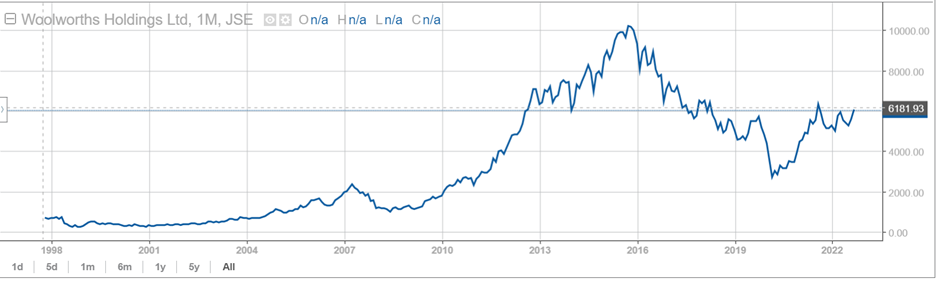
My view is very simple. I believe Woolies made a mistake in acquiring David Jones and should exit this company. I suspect it is being prettied up for a sale. The Woolworths share price is where it was in 2013. The PE is 15.2x, which is quite steep for a company with a pedestrian growth outlook. Much now depends on the prospects for a sale of the Australian operations. If David Jones and/or Country Road can be disposed of for a reasonable price, then the share may well react positively. If not, it will more likely remain in the doldrums.
Truworths: better results but unanswered questions
Which just leaves Truworths. On the face of it, this should have been CEO Michael Mark’s swansong. At the helm for 33 years, Mark was scheduled to pass the CEO’s baton to either CFO Manny Cristaudo or Truworths SA Deputy MD Sarah Proudfoot. At the results presentation, Mark made mention of succession but gave no specific date, noting only that it might be later this year or even slightly later. And he didn’t mention his successor by name. Perhaps Cristaudo and Proudfoot will share the responsibility?
The other item that was left in an unsatisfactory manner was Primark. Truworths won a court case against British/Irish retailer Primark in the Supreme Court of Appeal (SCA) which allowed them to use the Primark label in SA, as the British parent had not used the trademark since registering it many years ago. When questioned at presentations about the legalities of using the Primark label, Mark became visibly agitated and declined to enter into argument about the issue. After establishing a store base of 11 stores in the past year, Truworths has now abruptly terminated the use of the Primark label and will instead convert all of its Primark stores to the Sync label. Mark noted that the decision to terminate the use of the Primark label was taken in consultation with the British/Irish parent and was “very amicable”-whatever that means. He refused to elaborate on it.
Although Primark was tiny in the overall scheme of things, it was an indication that Truworths was prepared to examine the possibility of entering the low-end of the market. The only winners out of this long-running saga have been the lawyers. It will be instructive to see if the British parent company eventually decides to set up shop in SA in its own right.
One area that Truworths has got very right in recent times has been its UK subsidiary, Office. Three years ago it was struggling and apparently had a “for sale” sign on it. But Truworths has persevered with it and it has at long last delivered the goods. I asked Mark at last week’s presentation if, knowing what he now knows about the UK retail market and about Office specifically, he would still have made the decision to buy Office. Without hesitation, he responded in the affirmative. In fact, he was almost gushing n his praise of Office.
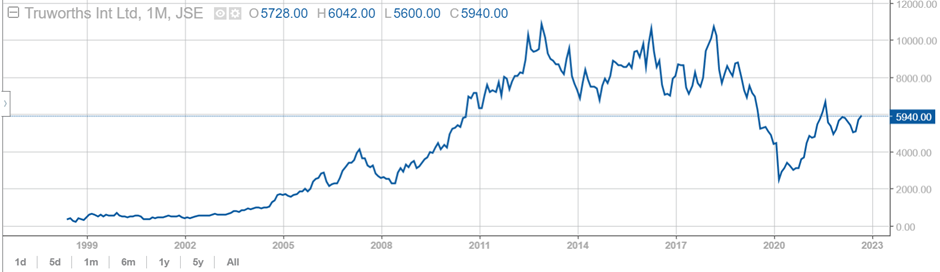
Truworths trades on a relatively undemanding PE of 9.4x. Growth has been elusive for this company for a number of years, especially top line growth. With a background of higher interest rates and languid economic growth in South Africa, it’s difficult to see where strong growth is coming from next year and beyond. And the UK is forecast to experience a five-quarter recession next year, according to the Bank of England. So no respite there either.