
A couple of weeks ago, Chris Gilmour took a detailed look at the non-discretionary retailers on the JSE. This includes the grocery stores and pharmacy chains. Last week, he began a journey into the discretionary retailers on the JSE, focusing on Woolworths in part 1. This week in part 2, Chris looks at Truworths in detail.
Truworths lags both The Foschini Group (TFG) and Mr Price in terms of vision, entrepreneurial flair and the ability to capitalise on market opportunities.
In part, this is probably due to complacency which has sunk into the organisation over many years. It still persists with an addiction to credit-fuelled growth in its main operations, whilst its competitors have long ago gone the predominantly cash route. And while both Mr Price and TFG have recently embarked upon meaningful acquisitions in order to grow their top lines, Truworths has put its excess cash into share buybacks.
Ex-growth under current management
Truworths remains a solid and operationally well-managed business, notwithstanding its ill-conceived foray into the UK retail market with the acquisition of Office six years ago. It remains well-run and offers shoppers a quality experience. However, it has gone ex-growth in recent years and that is unlikely to change under current management direction.
A five-year share price chart certainly tells a story:
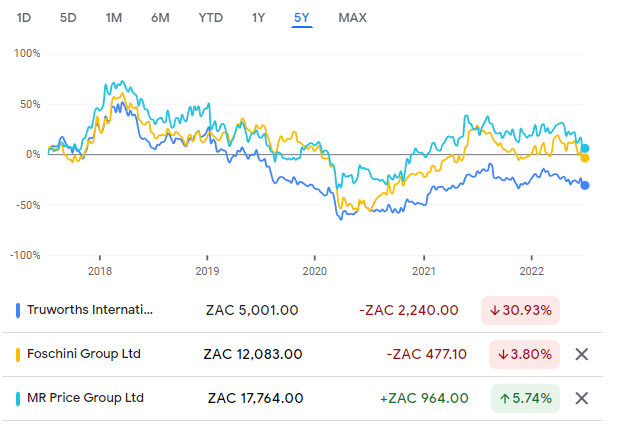
Long-time CEO Michael Mark will be retiring this year after over thirty years at the helm of the business. Generally speaking, he has had a good record in running the company, but Truworths now finds itself, in my opinion, at a watershed. Its products, although high-quality in the main, are perhaps priced somewhat too optimistically for the emerging middle-class market.
A generous separation
During the three decades of Michael Mark’s tenure, Mr Price has had four CEOs and TFG has had five. Mark was destined to retire from the job in the middle of last decade and his successor, Jean-Christophe Garbino, was named as CEO-designate and should have succeeded him in 2015. But the arrangement didn’t work out and Garbino abruptly resigned. To this day, no satisfactory explanation has been given for his departure, other than a comment in the Sunday Times from Mark that “it just didn’t work out”.

Garbino received payment in the amount of R25 million as compensation for loss of office on resignation as an executive director of the company on 4 December 2015. By the time he left he had attended three board meetings and received salary and benefits worth R2.2 million. This was a remarkably generous separation package by the Truworths board for someone who had scarcely set foot in the business.
Prior to his extremely short tenure at Truworths, Garbino had spent 22 years at Kiabi, a French budget fashion retailer, the last seven years of which being as CEO of the company. Perhaps his experience at Kiabi would have served him well had he stayed and set Truworths on a potentially different course. But that is in the realms of speculation and we will never know.
Although there has been a temporary improvement in certain of Truworths metrics in financial 2021, thanks to a favourable base effect when making comparisons with 2020, longer-term erosion is still intact.
Unless Truworths can change its top management direction, and quickly, it will likely see its financial metrics deteriorate even further and lose more ground to its competitors. This is reflected in the very poor rating of the share. On a Price/Earnings ratio of only 8.3x, Truworths is the second cheapest share in the retail sector.
The Primark trademark fight
A couple of years ago, Truworths started using the Primark label in South Africa, on the grounds that it hadn’t been used for at least five years by the Irish parent company and thus it had ceased to be protected. And although Truworths has won the first round in court, I believe that Primark will eventually win back its right of use from Truworths. There are at least two relatively recent precedents in SA law that inform us that Truworths is in the wrong.
It is understandable why Truworths wants to use the Primark label. Like Zara and H&M, it is lower-end and appeals to customers who want fashion at an extremely low price. And like Zara and H&M, it would probably gain a loyal following in SA very quickly for all the reasons mentioned earlier. Most importantly, it allows Truworths to gain a foothold in the lower-end fashion segment that is currently dominated by Mr Price and TFG. In so doing, it would be able to increase its top line.
Most, if not all of Primark’s South African customers would be totally oblivious of the fact that there is no relationship between Primark in SA and the real multinational Primark. This might backfire on Truworths in the longer term if South African customers access the genuine Primark website and discover that products shown there are not available in SA.
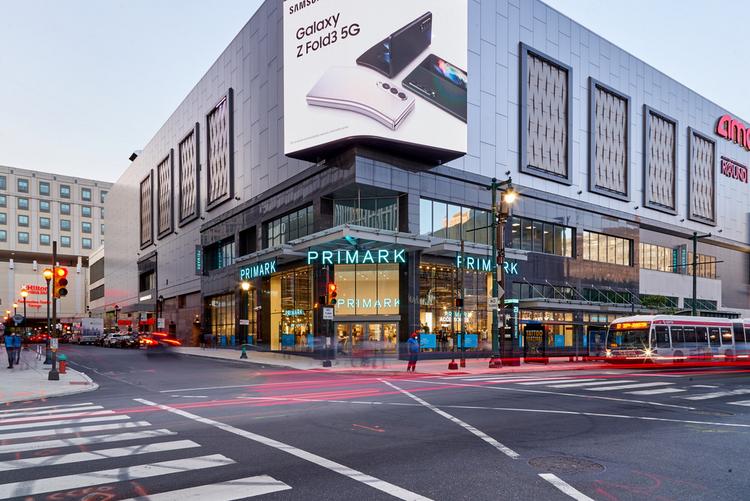
Primark, a subsidiary of Associated British Foods (ABF), first registered its Primark brand in SA in 1976 and to date has never used the trademark in SA. In South African law, a third party such as Truworths can cancel a trademark if it has not been used for five years. In 2018 Truworths filed a cancellation action against Primark’s registration for the Primark trademark on the grounds that this trademark was not subject to use. In the action at the time, Primark’s counter-argument was that, because Primark is an internationally well-known brand, the non-use of the trademark was irrelevant and that Primark’s registration should be protected from cancellation.
However, the Supreme Court of Appeal (SCA) disagreed, finding that although the Primark brand was well-known in the UK and elsewhere, it was not well-known in SA. Therefore it did not qualify for protection if it had not been used for five years.
But there was a sting in the tail that could ultimately be negative for Truworths in the longer term. The SCA commented on Truworths’ dishonest motivations and approach. In the initial court papers, Truworths stated that it only wanted to use the Primark label on some clothing lines without actually opening a chain of Primark stores. It has become clear that Truworths does indeed intend opening a chain of Primark stores. At end-June 2021, 11 Primark stores were operating in South Africa.
A similar legal situation can be found in the case of McDonalds, the well-known multinational fast-food chain in its actions against George Charalambous and his partner Chicken Licken founder George Sombonos. The two Georges attempted to use the McDonald’s trademark in SA in the 1990s on the grounds of non-use of the trademark. While they were partially successful in being allowed to use a slightly different version of the name (MacDonald’s instead of McDonald’s), Charalambous and Sombonos lost on appeal in 1996 and McDonald’s won the rights to use all of their own trademarks in SA.
Closer to Truworths’ business is the case of LA Retail vs the US Polo Association (USPA). LA Retail, a South African apparel producer, had produced copycat versions of the Ralph Lauren-owned Polo brand products in SA for many years. The only difference between Ralph Lauren’s original logo with two polo-playing horsemen and LA’s logo was that in the Ralph Lauren products, the players faced right and in the LA logo they faced left. LA and Ralph Lauren had an agreement going back many decades that they could use this arrangement in SA and both parties appeared to be happy.
But in 2019, the USPA and its SA affiliate Stable Brands (Pty) Ltd won an important legal battle against LA Group in terms of which over 40 LA Group trademarks using Polo in the name were required to be cancelled and expunged in the trademark register in SA.
Although Truworths has won the first round in its attempt to retain the use of the Primark label in SA, it should be noted that Primark intends to take “whatever steps are necessary to protect its trademark and hard-earned reputation” – Primark and ABF are formidable opponents. Not only is Primark a true multinational retailer, but parent company ABF has long-established links in many countries, including South Africa. It knows the South African corporate and legal landscape well and Primark will no doubt be well aware of the potential for its brand in South Africa.
I believe that the fight for Primark’s right of use of trademark in SA is far from over and that ultimately, Primark will win. In this event, Truworths will have to find an entirely new avenue for tapping into the lower-end fashion market. Truworths already has a lower-end fashion chain called Identity that could presumably be used to increase the group’s top line.
It therefore seems surprising that Truworths would want to go the potentially hazardous route of using a multinational brand such as Primark without the owner’s permission.

Very interesting insight on the Truworths/Primark saga. Essentially, Truworths has aided in acquainting South Africans with the Primark brand only to inevitably hand it over. Desperate cries for a change in leadership.